
By SPIE ICS SA · May 2026
Making Sustainable IT a driver of innovation: The choice of forward-thinking companies
The real question is not "how much does Sustainable IT cost?" but "how much does inaction cost?" Companies that have structured a Sustainable IT strategy see it confirmed year after year: SIT generates measurable value, well beyond a mere image effect.
Sustainable IT and business innovation: What are we really talking about?
Sustainable IT (SIT) refers to the full set of practices aimed at reducing the digital environmental impact of organisations while preserving their economic performance. It is not just another CSR trend: it is a cross-functional discipline that touches IT procurement, system architecture, employee usage patterns and the strategic roadmap.
Concretely, SPIE operates within this framework on two levels. Internally, the company has been awarded the Sustainable IT Label at level 2, attesting to a structured and recognised commitment. Externally, the ICS teams support their clients at every stage of their SIT maturity journey through their Sustainable IT Services: maturity diagnostics, lifecycle analysis, end-of-life equipment management through refurbishment, and employee awareness. This dual position as both practitioner and partner forms a coherent response to Sustainable IT transformation, understood in its full scope.
Why the cost question is framed incorrectly
When senior management evaluates an SIT investment, it calculates the entry cost: audits, migrations, training, certifications. What this analysis overlooks are the cost of inaction.
An unoptimised IT infrastructure consumes significantly more energy than a rationalised architecture, without this overconsumption always being visible in dashboards. Equipment operated beyond its economic lifespan generates breakdowns, maintenance costs and underestimated security risks. In turn, equipment replaced too early generates unnecessary costs and increases the organisations environmental impact. A company that does not anticipate its Sustainable IT transformation today will pay tomorrow to comply in a rush with regulatory requirements it could have integrated gradually. Long-term economic performance clearly favours organisations that have structured their approach in advance.
Optimising an IT infrastructure generates measurable energy savings from the first year: server consolidation, reduced idle consumption, improved equipment lifecycle management. For a mid-sized fleet, the budget impact is far from negligible.
SIT as a driver of operational cost reduction
IT infrastructure optimisation is one of the most immediate levers of a Sustainable IT strategy. Consolidating servers, virtualising environments, rationalising software licences and migrating to cloud offerings with documented carbon footprints: each of these actions typically generate direct savings on the operational budget.
The eco-design of digital services, often perceived as a technical constraint, produces applications that are lighter, faster and less resource intensive. This performance gain simultaneously benefits the user experience and the hosting bill.
Lifecycle extension: An underestimated lever for CFOs
Replacing terminals every three years out of habit is a costly decision, both financially and environmentally. Extending the lifespan of a workstation or server mechanically reduces its annualised carbon footprint, since manufacturing generally concentrates most of the impact across the full lifecycle, while deferring capital expenditure. Sustainable IT practices around the IT estate (asset audits, internal refurbishment, reuse) represent a concrete source of optimisation that is often invisible in conventional dashboards.
SIT as a competitive advantage in the talent and client markets
Employer attractiveness takes on a new dimension in this context. According to a CSA study for LinkedIn and ADEME, 78% of employees say, all else being equal, that they would choose a company committed to ecological transition – a proportion even more pronounced among those under 35. Organisations that put forward a credible, measurable Sustainable IT strategy recruit more easily, retain better and reduce their turnover costs.
On the B2B client side, procurement tenders now systematically incorporate CSR criteria. Large Swiss companies operating in the European market or integrated into value chains subject to CSRD are increasingly exposed to scope 3 emissions reporting requirements and evaluate their IT suppliers accordingly on their carbon footprint. A supplier that cannot answer these questions loses contracts. A supplier that anticipates them turns this requirement into a structural competitive advantage.
Frugal innovation: When constraint becomes a driver of digital innovation
The history of digital innovation is marked by examples where constraint produced better solutions. Green software design, by forcing teams to reduce resource consumption, often leads to more robust architectures that are less dependent on heavy infrastructure.
Organisations that have embedded these principles report shorter development cycles, more resilient services and better control over hosting costs. Combining innovation and sustainability is not a compromise: it is a more demanding design direction that produces superior results over the long term.
A web application designed to run on older devices and slow connections reaches a broader market, costs less to host and generates a lower digital carbon footprint. Reduced environmental impact and economic performance point in the same direction here.
Anticipating regulation: The silent competitive advantage
The CSRD directive imposes structured non-financial reporting on a growing number of European companies – a scope that, despite the European Commission's simplifications adopted in 2026, remains significant. Swiss companies are not directly subject to this directive, but they are constrained by it indirectly: their European clients demand comparable data from their entire value chain, and those with subsidiaries in the EU fall within its scope as the thresholds apply.
Organisations that have anticipated the sustainable IT transformation by equipping themselves with reliable performance indicators, documenting their digital emissions, and structuring their internal digital governance are not caught scrambling. They have turned a regulatory constraint into a competitive advantage. Those who wait face a double penalty: emergency compliance costs, and the risk of losing tenders currently under evaluation.
Digital governance and strategic steering: The key that changes everything
Without formalised digital governance, Sustainable IT remains a set of scattered initiatives, difficult to present to executive committees. What distinguishes a company that "does SIT" from a company that derives a real competitive advantage from it, is the strategic steering structure.
Key Elements of effective SIT governance
- An identified SIT lead with a clear mandate and allocated resources
- Defined and regularly measured performance indicators: energy consumption per device, equipment reuse rate, digital carbon footprint of critical applications
- Reporting integrated into the executive dashboard
- A multi-year budget dedicated to IT estate optimisation
- A skills development plan for employees on sustainable digital practices
This strategic steering is no different from that of a classic IT transformation project: clear objectives, regular measurement, continuous adjustment. What changes is that the benefits are simultaneously financial, reputational and regulatory.
Return on investment: Concrete indicators to convince your management
The return on investment of a Sustainable IT strategy can be read across several dimensions simultaneously. Rather than seeking a single ROI figure, the aim is to identify the combination of levers that reinforce each other in your specific context.
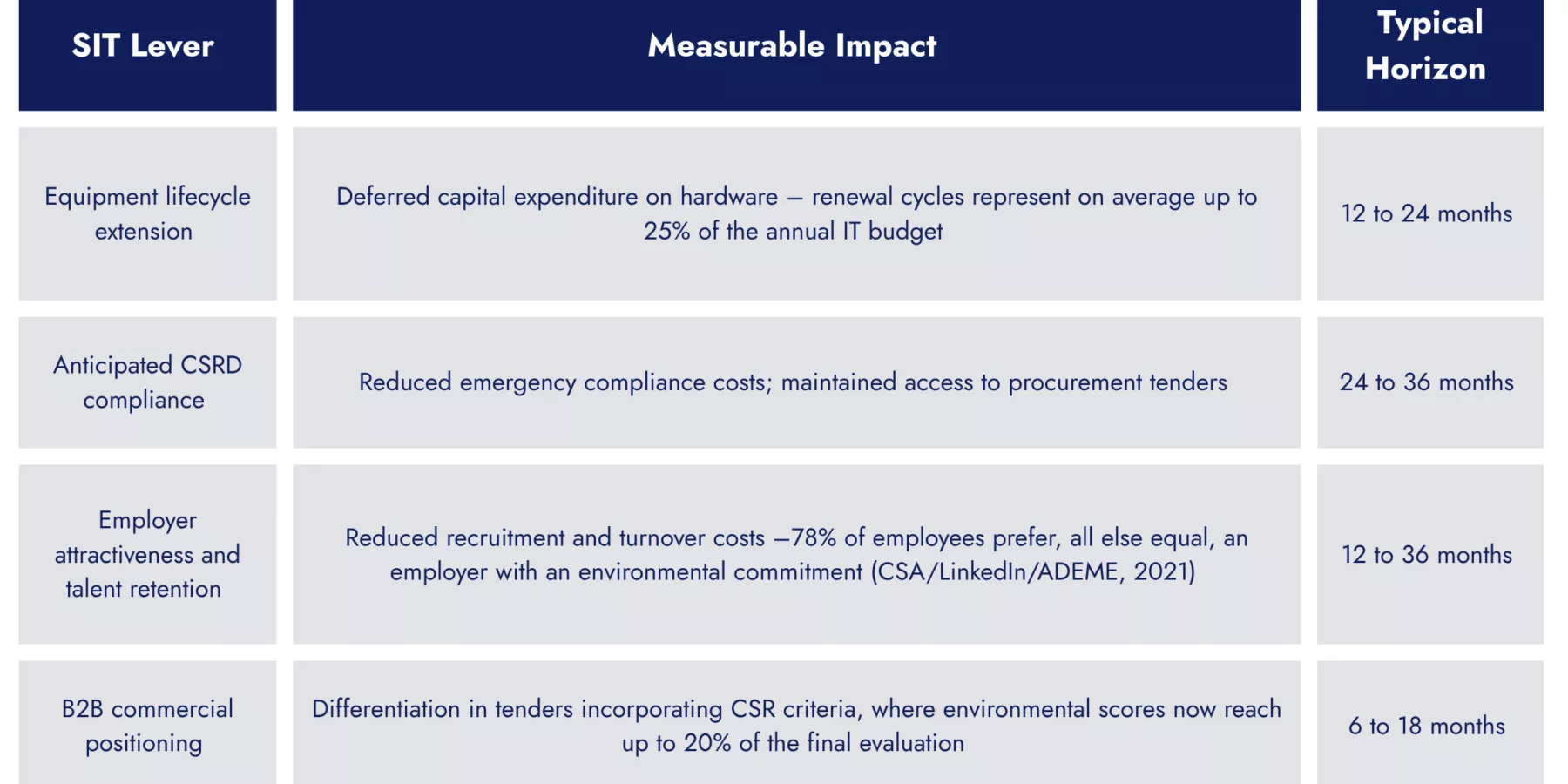
These timelines and orders of magnitude are indicative and vary according to the organisation's starting maturity level and the scope of actions undertaken.
How to anticipate the transformation and start without delay
Anticipating the transformation does not require a five-year plan before acting. The first steps are often rapid audits that immediately reveal concrete optimisation margins.
- Inventory IT energy consumption: servers, workstations, cloud solutions, network peripherals. This is the starting point for any serious steering.
- Map the IT estate: age of equipment, actual utilisation rate, total cost of ownership per asset.
- Identify high-carbon-impact applications and prioritise eco-design initiatives according to their frequency of use.
- Define two or three priority performance indicators to integrate directly into the executive dashboard.
- Align the Sustainable IT strategy with the company's CSR strategy to avoid duplicating reporting efforts and to capitalise on every data collection exercise.
Supporting sustainable digital transition does not require reinventing everything. It begins with an honest reading of the current situation and a prioritisation of high-leverage actions. Companies that have already taken this step confirm that the first tangible results arrive well before the end of the first year.
Frequently asked questions on Sustainable IT in business
Does Sustainable IT generate a measurable return on investment?
Yes. Return on investment is measured across several dimensions simultaneously: reduction of IT energy costs, decreased hardware expenditure through lifecycle extension, and savings on regulatory compliance costs. Initial infrastructure optimisations typically produce visible effects within 24 months.
What is the difference between Green IT and Sustainable IT?
Green IT refers specifically to practices aimed at reducing the environmental impact of IT equipment and infrastructure: data centre energy efficiency, lifecycle extension, green software design. Sustainable IT is a broader concept that also encompasses the social, ethical and governance dimensions of digital usage within the organisation.
Are Swiss companies affected by CSRD regulations?
Directly, the CSRD now targets a much narrower set of large European companies following the Omnibus simplification package. The directive primarily applies to companies with more than 1,000 employees and over €450 million in net turnover, significantly raising the previous thresholds. However, large Swiss companies remain directly affected. Regardless of this reduced scope, Swiss companies continue to face requests from their clients for Scope 3 emissions data. Anticipating this requirement therefore constitutes an immediate competitive advantage, rather than merely a future constraint.
Where to start a Sustainable IT strategy in a company?
The most effective starting point is an audit of the IT fleet energy consumption and a mapping of the IT estate (age of equipment, utilisation rates, total cost of ownership). This data allows you to prioritise high-leverage actions without mobilising a significant budget. Such an audit can be carried out via a lifecycle analysis within a few weeks with targeted support.
Does Sustainable IT hold back digital innovation?
No, quite the opposite. Eco-design and architecture optimisation produce systems that are more performant, more resilient and less costly to operate. The SIT constraint forces teams to question the relevance of every feature and every layer of infrastructure, which leads to more robust and reversible digital transformation decisions.
Ready to make Sustainable IT a performance driver for your organisation?
Forward-thinking companies do not wait for regulation to catch up with them. They use SIT as a driver of optimisation, attractiveness and digital innovation today. SPIE's experts support you in assessing your SIT maturity and defining the first high-impact actions.